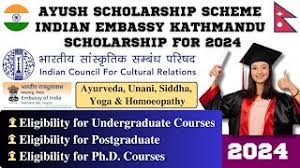
For international students passionate about traditional medicine, India offers an extraordinary opportunity that combines world-class education with full financial support. The AYUSH Scholarship Scheme, administered by the Indian Council for Cultural Relations on behalf of the Ministry of AYUSH, brings students from across the globe to study Ayurveda, Yoga, Unani, Siddha, and Homoeopathy at premier Indian institutions . If you have ever dreamed of mastering these ancient healing systems at their source, this scholarship could be your gateway.
AYUSH is an acronym that represents India’s five traditional medicine systems: Ayurveda, Yoga, Unani, Siddha, and Homoeopathy . These disciplines have gained tremendous international recognition in recent years, and the demand from foreign students to study them in India has grown significantly . Recognizing this interest, the Government of India created this scholarship program to support talented students in pursuing formal degrees in these fields .
What makes this scholarship particularly valuable is its comprehensive coverage. Successful applicants receive full tuition coverage for the duration of their program . A monthly living allowance is provided based on the level of study: undergraduate students receive ₹18,000 per month, MD students receive ₹35,500 in their first year increasing to ₹38,000 in subsequent years, and PhD scholars receive ₹43,500 per month . A contingent grant covers academic expenses, with ₹4,500 per year for undergraduate and diploma students and ₹12,000 per year for PhD and MD students . House rent allowance up to ₹6,500 per month is provided based on actual costs, with higher allowances in major cities . Round-trip economy class airfare from your home country to India is covered once at the time of admission and once after course completion . Additional support includes thesis and dissertation expenses, with ₹10,000 for PhD scholars and ₹7,000 for MD students .
The scholarship offers courses at multiple levels. Undergraduate programs include Bachelor of Ayurvedic Medicine and Surgery (BAMS), Bachelor of Siddha Medicine and Surgery (BSMS), Bachelor of Unani Medicine and Surgery (BUMS), and Bachelor of Homoeopathic Medicine and Surgery (BHMS) . These are five-and-a-half-year degree courses including one year of mandatory clinical training . Three-year undergraduate programs are also available in B.Sc. Yoga and B.A. Yoga Shastra .
Postgraduate programs include MD in Ayurveda, Siddha, Unani, and Homoeopathy, each lasting three years and requiring the relevant undergraduate degree recognized by the Central Council of Indian Medicine . M.Sc. in Yoga is a two-year program open to graduates from any discipline .
For doctoral-level study, PhD programs are available in Ayurveda, Unani, and Yoga, with durations ranging from three to five years . PhD applicants must hold a relevant MD degree recognized by CCIM, or for Yoga, any postgraduate degree .
Eligibility requirements vary by program level. For undergraduate courses in BAMS, BSMS, BUMS, and BHMS, you must have completed 12 years of schooling with science subjects including Physics, Chemistry, and Biology . For B.Sc. Yoga and B.A. Yoga Shastra, 12 years of schooling in any stream is sufficient . For postgraduate programs, you need the relevant undergraduate degree recognized by CCIM or CCH . For PhD programs, you need the relevant MD degree . All applicants must be at least 18 years old at the time of admission . For undergraduate and postgraduate programs, the maximum age is typically 40 years, while for PhD programs it extends to 50 years . English proficiency is essential as courses are taught in English, and shortlisted applicants may be asked to appear for an English test or interview .
The application process is conducted through the ICCR A2A Scholarship Portal at a2ascholarships.iccr.gov.in . For the 2026-27 academic year, applications open on February 27, 2026, and close on April 15, 2026 . When applying, you can select up to five preferred universities and courses in order of preference . If seats are not available at your chosen institutions, the Ministry of AYUSH may allocate you to another university where seats exist . Some countries may have additional requirements. In Nepal, for example, applicants must pay an application fee of NRs. 400 and submit physical documents to the Embassy . You should check with your local Indian Embassy or High Commission for country-specific procedures .
A crucial note: applications must be submitted directly by the applicant. Indian missions explicitly state that they do not recognize or accept applications through education consultants or agencies, and such applications are liable to be rejected . The process is designed to be direct and accessible, and you should handle it yourself .
Once your application is submitted, the Indian diplomatic mission in your country forwards it to ICCR for scrutiny and placement . Universities then review applications based on their own eligibility criteria . A scholarship is awarded only when admission is confirmed by ICCR after receiving confirmation from the concerned institution . After confirmation, appropriate visas are issued through the Indian mission or through the Study in India portal .
The allocation of scholarships varies by country and region. For general international applicants, 50 slots are available across UG and PG programs . WHO South-East Asia Region countries receive 29 reserved seats in national institutes for specific programs . Malaysia receives 20 slots for undergraduate programs, and Africa receives 5 slots for UG programs and a one-year Diploma in Yoga . These allocations reflect India’s commitment to building educational partnerships across the developing world .
For international students passionate about traditional medicine, the AYUSH Scholarship Scheme offers a rare opportunity to study these ancient systems in the country where they originated, with all expenses covered. The application window is open, the requirements are clear, and thousands of students from around the world have successfully navigated this path before you. Your journey to mastering Ayurveda, Yoga, Unani, Siddha, or Homoeopathy in India could begin with your application today.
Conclusion
The AYUSH Scholarship Scheme represents something unique in the landscape of international education. While most scholarships focus on engineering, technology, or management, this program celebrates and preserves knowledge systems that have sustained human health and well-being for thousands of years. It invites international students not just to learn, but to become custodians of traditions that India considers part of its cultural heritage.
For students who choose this path, the experience goes beyond lectures and examinations. You study Ayurveda in the land where it was first practiced, learning from practitioners who have inherited generations of knowledge. You explore Yoga in the country that gave it to the world, understanding philosophy alongside asanas. You immerse yourself in Unani, Siddha, and Homoeopathy at institutions that are centers of excellence in these fields. The education you receive is authentic, grounded in tradition yet informed by modern research.
Frequently Asked Questions
What does AYUSH stand for?
AYUSH is an acronym representing India’s five traditional medicine systems: Ayurveda, Yoga, Unani, Siddha, and Homoeopathy. The Ministry of AYUSH was established in 2014 to promote and regulate these systems, and the scholarship program is administered on its behalf by the Indian Council for Cultural Relations.
Who is eligible for these scholarships?
Eligibility varies by program. For undergraduate medical courses (BAMS, BSMS, BUMS, BHMS), you must have completed 12 years of schooling with Physics, Chemistry, and Biology. For Yoga programs, any stream is acceptable. Postgraduate applicants need the relevant undergraduate degree recognized by CCIM or CCH. PhD applicants need the relevant MD degree. Age limits are generally 40 years for UG and PG, and 50 years for PhD programs.
What expenses does the scholarship cover?
The scholarship is fully funded. It covers full tuition, a monthly living allowance (₹18,000 for UG, ₹35,500-38,000 for MD, ₹43,500 for PhD), house rent allowance up to ₹6,500 per month, a contingent grant for academic expenses, thesis and dissertation support, and round-trip economy airfare from your home country to India.
Do I need to know Hindi or any Indian language?
No, all AYUSH courses are taught in English. You must have proficiency in English to follow lectures, read textbooks, and complete assignments. While learning some local language may help with clinical interactions, it is not required for admission or completion of your program.
Do I need to take the NEET exam for admission?
For undergraduate AYUSH programs (BAMS, BSMS, BUMS, BHMS), international students are not required to take NEET. Admission is based on your academic qualifications and the scholarship selection process. However, some institutions may have their own entrance requirements, so check with your assigned university.
Can I apply for multiple courses or universities?
Yes, through the ICCR A2A portal you can select up to five preferred universities and courses, ranked in order of preference. If seats are not available at your chosen institutions, the Ministry of AYUSH may allocate you to another university where seats exist.
Is there an application fee?
Application fees vary by country. Some countries, like Nepal, require a nominal fee (NRs. 400). Other countries may have no fee. Check with the Indian Embassy or High Commission in your country for specific requirements. Be wary of anyone asking for large fees, as the scholarship application process is generally low-cost or free.
Can I apply through an education consultant or agency?
No. Indian missions explicitly state that applications received through education consultants or agencies are liable to be rejected. The application process is designed to be direct and accessible. You should complete and submit your application yourself through the official channels.